
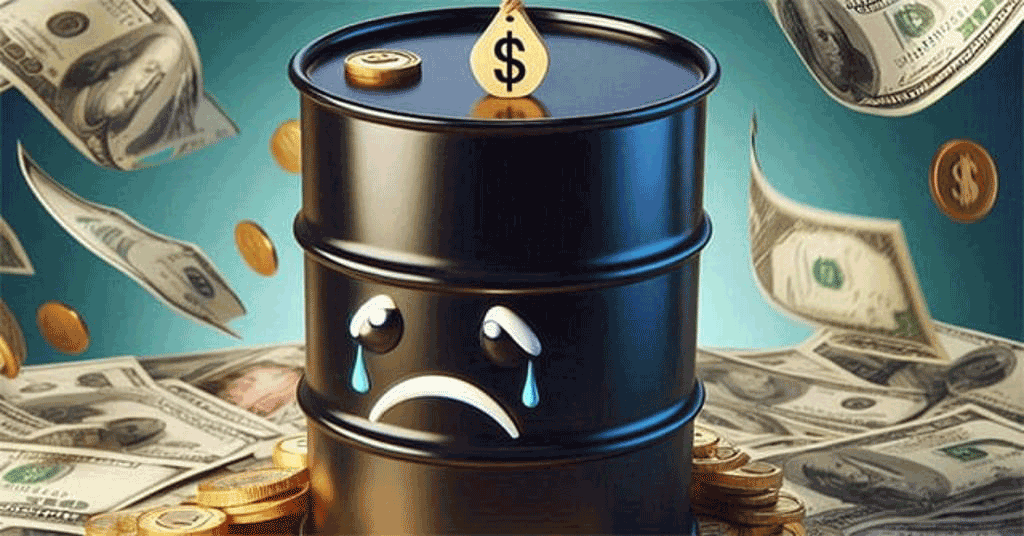
OPEC output, weak demand and global politics are flooding the market. Experts warn an oil supply glut could hit by 2026

Global oil markets are bracing for a long-term downturn, driven by rising supply, softening demand and mounting economic headwinds.
Brent crude closed Friday at US$66.68 per barrel, down 76 cents or 1.1 per cent. West Texas Intermediate dropped 89 cents to US$62.68, a 1.4 per cent decline. While markets initially hoped an interest rate cut by the U.S. Federal Reserve might boost consumption, oversupply concerns have taken the wheel.
The International Energy Agency now projects a market surplus of 3.3 million barrels per day (bpd) by 2026 if current policies remain in place. Global supply is expected to rise by 2.7 million bpd in 2025 and another 2.1 million in 2026, while demand will grow by just 700,000 bpd annually.
The U.S. Energy Information Administration echoes the concern. Its latest Short-Term Energy Outlook forecasts global petroleum and other liquid fuels production to average 105.5 million bpd in 2025, climbing to 106.6 million bpd in 2026. Consumption will lag at 103.8 million and 105.1 million bpd, respectively.
Adding to the unease, U.S. distillate stockpiles—diesel, jet fuel and other products held in storage—unexpectedly rose by four million barrels, suggesting that more fuel is going unused and demand is starting to stall.
Beyond market fundamentals, some of the bearish pressure is also political. OPEC, the Organization of the Petroleum Exporting Countries, is increasing production—partly shielded by U.S. President Donald Trump’s push for lower domestic fuel prices, a priority that influences how much pressure Washington applies to oil-producing nations.
The White House has made clear it wants energy affordability, giving oil producers the political cover to keep pumping without fear of retaliation.
Geopolitical dynamics are compounding the supply picture. A recent thaw in U.S.–China relations reduced the likelihood of secondary sanctions over Chinese imports of Russian crude. Trump and Chinese President Xi Jinping are expected to meet at the upcoming Asia-Pacific Economic Cooperation summit at the end of October.
Markets took comfort in Trump’s silence on Chinese oil purchases, seeing it as a signal that confrontation is off the table, at least for now.
India continues to buy Russian oil, and the European Union’s latest sanctions package lacks the strength to provoke a firmer U.S. response. Together, these factors are helping keep Russian barrels in global circulation.
Elsewhere, Iraq appears close to resuming crude exports from its Kurdistan region to Turkey, adding yet another stream of supply to an already saturated market.
On top of all this, the upcoming refinery turnaround season—a routine drop in crude demand as refineries shut down for maintenance—will temporarily reduce consumption even further.
In short, all the major levers are pulling in the same direction: lower prices.
And while that may seem like good news for consumers, the ripple effects are far more serious. Canadians may welcome cheaper gas in the near term, but the implications go far beyond the pump.
A prolonged downturn could hit investment in Alberta’s oil sands, Newfoundland and Labrador’s offshore sector, and Saskatchewan’s oil-producing regions—each of them key drivers of provincial revenue and the Canadian economy. Lower prices mean reduced royalties, which fund everything from health care to infrastructure.
Non-renewable resource revenues—primarily from oil and gas—remain a significant source of income for these provinces. In Alberta, they are forecast to account for roughly 21.5 per cent of total government revenue in 2025–26. In Newfoundland and Labrador, oil royalties alone are projected to contribute about 15 per cent of the province’s revenue. Even in Saskatchewan, where potash and uranium also play a role, oil and gas revenues make up a substantial share of the 12.8 per cent of income tied to non-renewable resources.
These figures underscore just how exposed provincial finances remain to global oil price movements.
That pullback in investment could also slow hiring and capital spending, with ripple effects across energy-dependent regions. Pension funds and institutional investors with heavy exposure to oil and gas may feel the sting as well.
At the national level, the consequences could be far-reaching. Canada’s oil and gas extraction sector alone accounts for about 3.2 per cent of GDP, according to the Canadian Association of Petroleum Producers. Broader estimates that include investment, supply chains and related industries place the sector’s total contribution at around 6.4 per cent, based on previous Canadian Energy Centre analysis.
Lower crude prices tend to weaken the Canadian dollar, slow investment in big projects, and cut into export earnings. That can drag down GDP growth, shrink government revenues, and affect job markets even outside the oil patch.
In a country where energy exports still drive much of the economy, a prolonged slump could have wide-reaching fiscal and economic consequences.
Investors, governments and energy workers alike should brace for impact—the oil market isn’t just cooling, it’s being flooded.
Toronto-based Rashid Husain Syed is a highly regarded analyst specializing in energy and politics, particularly in the Middle East. In addition to his contributions to local and international newspapers, Rashid frequently lends his expertise as a speaker at global conferences. Organizations such as the Department of Energy in Washington and the International Energy Agency in Paris have sought his insights on global energy matters.
Explore more on World economy, Energy sector, OPEC, Canadian economy
The views, opinions, and positions expressed by our columnists and contributors are solely their own and do not necessarily reflect those of our publication.
Troy Media empowers Canadian community news outlets by providing independent, insightful analysis and commentary. Our mission is to support local media in helping Canadians stay informed and engaged by delivering reliable content that strengthens community connections and deepens understanding across the country.

